
TAG Heuer CAH1111 Formula 1 Watch.
The TAG Heuer CAH1111 Formula 1 is a fantastic entry point into the world of luxury sport watches. While some purists may prefer a mechanical

The pursuit of small game and pests with an air rifle introduces a deliberate challenge compared to traditional firearms, requiring a profound understanding of ballistic performance for effective use. A hunter wielding an air rifle necessitates a heightened awareness of air gun ballistics compared to their firearm counterpart. Take, for instance, a .22 long rifle cartridge firing a 40-grain bullet at around 1200 ft/sec versus a potent .22 caliber air rifle like the Benjamin Discovery or Marauder propelling a 14.3 grain pellet at approximately 900 ft/sec. The stark contrast in muzzle energy is evident – the firearm boasting about 130 ft lbs, whereas the air rifle only yields around 26 ft lbs. Despite the occasional claim that an air rifle “shoots as hard as a .22,” the reality is that firearms, particularly big bore .357 pre-charged pneumatics, surpass the power of any air rifle.
While velocity is a crucial factor in air gun ballistics, it’s not the sole consideration. Advertised velocities often rely on lightweight pellets, providing optimistic estimates. For example, in .177 caliber, a light pellet may weigh 6.7 grains, while a normal one tips the scales at 7.9 grains, and a heavy variant could reach 10 grains. This weight difference can lead to significant velocity variations, with heavier pellets potentially clocking 100-150 ft/sec lower than their lighter counterparts. The consequence is that a break action rifle promoting 1000 ft/sec might only achieve 875-900 ft/sec with typical pellets.
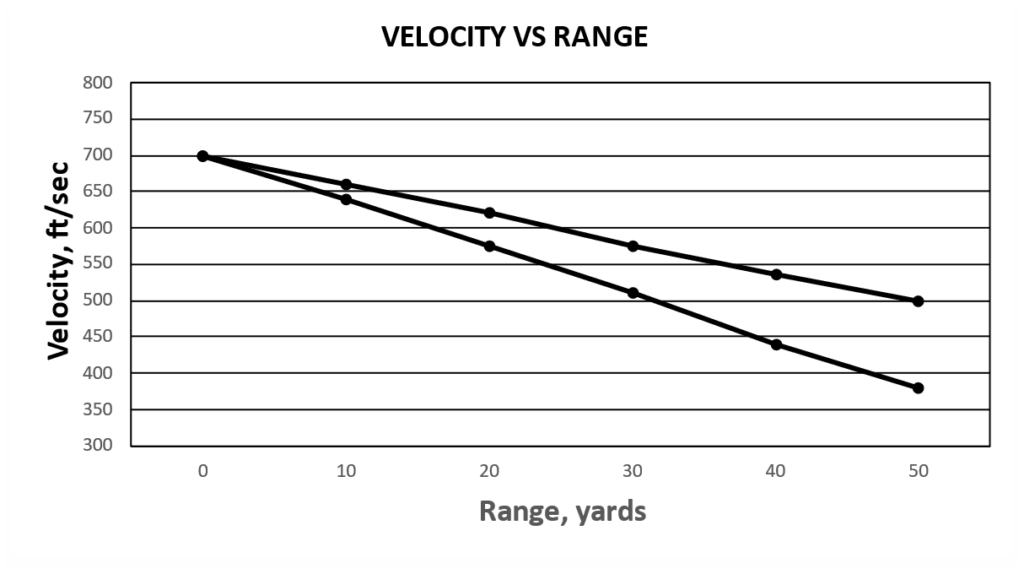
Beyond sheer power, the trajectory of air gun projectiles differs from that of firearm bullets due to aerodynamic inefficiencies. Pellets lack the streamlined design of firearm bullets, leading to rapid velocity loss. Even .22 rimfire rifle bullets struggle to penetrate air compared to centerfire rifle bullets. The ballistic coefficient, representing a projectile’s ability to maintain velocity through air, illustrates this; a .22 caliber pellet may have a coefficient around 0.028, while a typical .22 long rifle bullet reaches approximately 0.125. Consequently, air rifle pellets not only start with lower muzzle velocity but also lose speed more swiftly, resulting in pronounced curvature and susceptibility to wind drift. The effective range of an air rifle falls short of a .22 rimfire, demanding awareness of these limitations in pellet gun ballistics.
In the realm of .177 caliber air guns, a notable advantage emerges with higher velocity yielding trajectories with less curvature. This advantage aids in targeting smaller objects, although larger diameter pellets hit harder. The real-world effectiveness of air gun ballistics hinges on the hunter’s skill, especially when aiming at diminutive targets from distances of 40-50 yards.
Choosing a larger caliber becomes preferable for small game hunting, as heavier pellets deliver more impact. The ability of heavier pellets to retain velocity effectively enhances their performance, making them a practical choice for the discerning hunter.
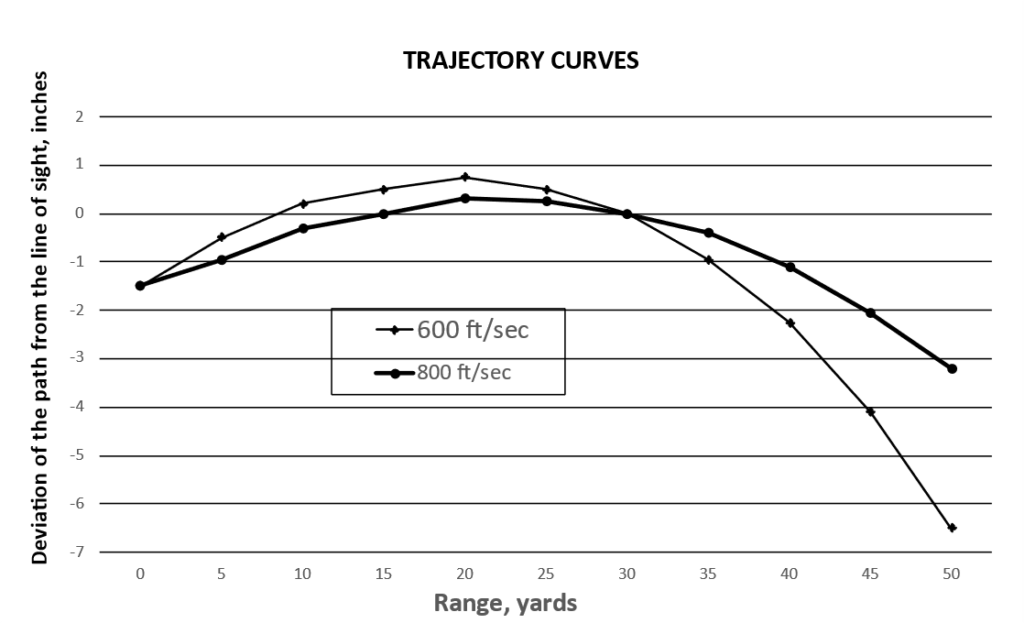
Projectile trajectory, influenced by gravity, introduces a curved path or trajectory. Sighting discrepancies arise because the bore is below the line of sight, particularly with scope sights. To mitigate this, sights align slightly upward, causing the projectile to begin its trajectory in an upward direction. The rifle is sighted in at two distances, with the longer distance typically considered the primary sighting range. The importance of a higher muzzle velocity becomes evident when assessing trajectories at different velocities and distances, emphasizing the advantage of faster-moving pellets for hitting targets at extended ranges.
The ballistic coefficient plays a pivotal role, with higher values indicating less velocity loss. Two pellets with coefficients of 0.010 and 0.020, both launched at 900 ft/sec, illustrate the substantial difference in remaining velocity over a 50-yard range. The pellet with a coefficient of 0.020 retains approximately 160 ft/sec more velocity than its less efficient counterpart, emphasizing the impact of the ballistic coefficient on kinetic energy.
Altitude introduces a unique aspect to air gun ballistics, reminiscent of the challenges faced at high altitudes during physical activities. At higher altitudes, air density decreases, affecting the air drawn into the compression chamber of break action rifles. This results in lower muzzle velocities, with tests indicating reductions of 6-7% at 5,500 ft and approximately 11-12% at 8,000 ft. Multi-pump rifles face similar challenges, drawing in less air at high altitudes, leading to lower velocities. However, a few additional pump strokes can compensate for this phenomenon. Pre-charged pneumatic rifles and CO2-powered rifles exhibit altitude-independent velocities, with their performance unaffected by changes in atmospheric pressure.
Understanding air gun ballistics is paramount for hunters, necessitating a grasp of the limitations imposed by power, accuracy, and skill. Attempting to extend the range of an air rifle beyond its capabilities is ill-advised. The choice of caliber, pellet weight, and awareness of atmospheric conditions contribute to a successful hunt within the established limits of air gun ballistics.
The TAG Heuer CAH1111 Formula 1 is a fantastic entry point into the world of luxury sport watches. While some purists may prefer a mechanical
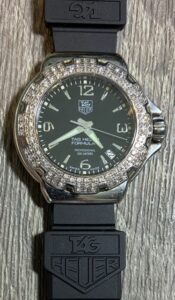
The TAG Heuer WAC1214 Formula 1 Diamond Watch strikes a perfect balance between a high-performance sports watch and a glamorous piece of jewelry. It’s a

The TAG Heuer 384.513/1 is a fascinating and important watch. It’s a reminder of a pivotal time in horological history and a testament to TAG